






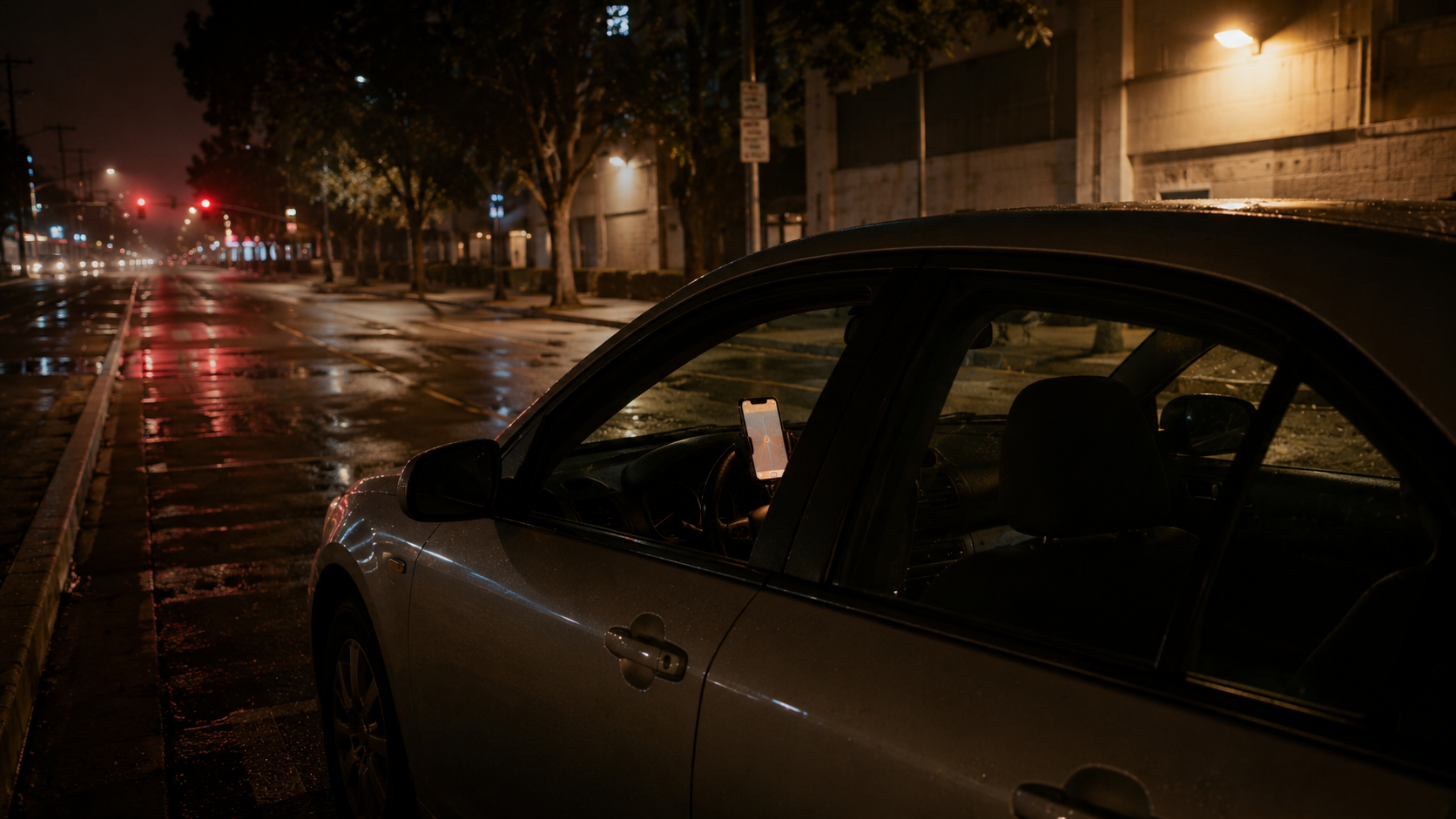
When most people think about Uber or Lyft accidents, they picture a passenger in the back seat after a crash. But California's rideshare law doesn't actually care where you were sitting. It cares about what the driver's app was doing the moment the crash happened.
That single fact — what the app was doing — controls whether you're covered by a $50,000 minimum policy or a $1,000,000 commercial policy. It controls whether Uber/Lyft pays at all, or whether they walk away and leave you fighting the driver's personal insurer. It controls the entire economic outcome of your case.
And almost no injured Californian — passenger, pedestrian, or other driver — knows it exists.
the four periods that control everything
California's Public Utilities Code (sections governing "Transportation Network Companies") divides rideshare driving into four operational periods. Each one has different insurance coverage. The rideshare company's million-dollar commercial policy is only active in certain periods. Outside those periods, you're stuck with whatever the driver's personal auto insurance provides — which is usually a $15,000–$50,000 minimum policy.
The difference between periods isn't a technicality. It's the difference between a recoverable case and a financial dead end.
Who pays when - the coverage map
Here is what California requires Uber, Lyft, and similar companies provide in each period.
The jump from Period 1 to Period 2 is the single largest moment in rideshare insurance law. The same crash, with the same injuries, can be worth twenty times more if the driver had accepted a ride request thirty seconds before impact.
why this matters for you specifically
If you were a passenger
You were almost certainly in Period 3 (passenger in car). The full $1,000,000 policy applies. Uber/Lyft will try to direct you to the driver's personal insurance anyway. Don't accept that framing.
If you were another driver hit by an Uber/Lyft vehicle
The period depends on what the driver was doing. If the driver was waiting for a ride (Period 1), you're looking at a $50,000/$100,000 contingent policy that only kicks in if the driver's personal insurance denies coverage. If the driver had accepted a ride or had a passenger (Periods 2 or 3), the full million-dollar policy applies.
If you were a pedestrian or cyclist hit by an Uber/Lyft
Same as above. Your recovery depends entirely on the app's status at the moment of impact.
how uber and lyft exploit the gaps
The companies have built an entire risk-management strategy around the period system. Here's what they do:
They direct you to the driver's personal insurer first
Uber's and Lyft's initial claim response often pushes you to file with the driver's personal auto insurance. They know that policy is usually inadequate — but if you file there first and exhaust it, the path back to the rideshare policy becomes complicated. The company has bought time and may have created defenses.
They dispute which period applied
Without independent evidence, Uber and Lyft can claim the driver was in Period 0 (app off) or Period 1 (waiting) at the moment of impact. Internal trip logs are the only objective record, and you don't have access to them. They do. They will not volunteer the information unless they have to.
They invoke the "independent contractor" status
Despite the period system, Uber/Lyft frequently argue they are not liable because the driver is an independent contractor. This argument has been litigated repeatedly in California. Properly handled, it does not protect the rideshare company from period-based coverage obligations. But the argument shows up in nearly every initial claim response.
They offer a fast, low settlement
A passenger with serious injuries may receive an initial offer in the range of $25,000 to $75,000 within days. The same case, fully developed under the correct period, often settles for $200,000 to $700,000 or more. The fast offer is designed to close the file before the period analysis is done.
the trip logs is the whole case
The single most important piece of evidence in any Uber/Lyft case is the trip log — the internal record of exactly what the driver's app was doing at the moment of the crash. Was the app on? Was a ride accepted? Was a passenger logged in?
The companies have this log. They will not produce it voluntarily. It must be obtained through a properly documented claim or, if necessary, formal discovery. Without it, the period determination is whatever Uber/Lyft says it is — and they will say whatever favors the lowest possible coverage.
An attorney handling a California rideshare case who does not immediately demand the trip log is missing the central piece of the case.
the bottom line
Rideshare accidents are not regular car accidents. The same crash can be worth twenty times more depending on what was happening on the driver's phone screen at the moment of impact.
If you were in, on, near, or hit by an Uber or Lyft vehicle in California — passenger, driver, pedestrian, cyclist, or otherwise — the first question is not "who's at fault." The first question is "which period was this." Until that's answered, you don't know what your case is worth. And Uber and Lyft are counting on you not asking.

.png)