





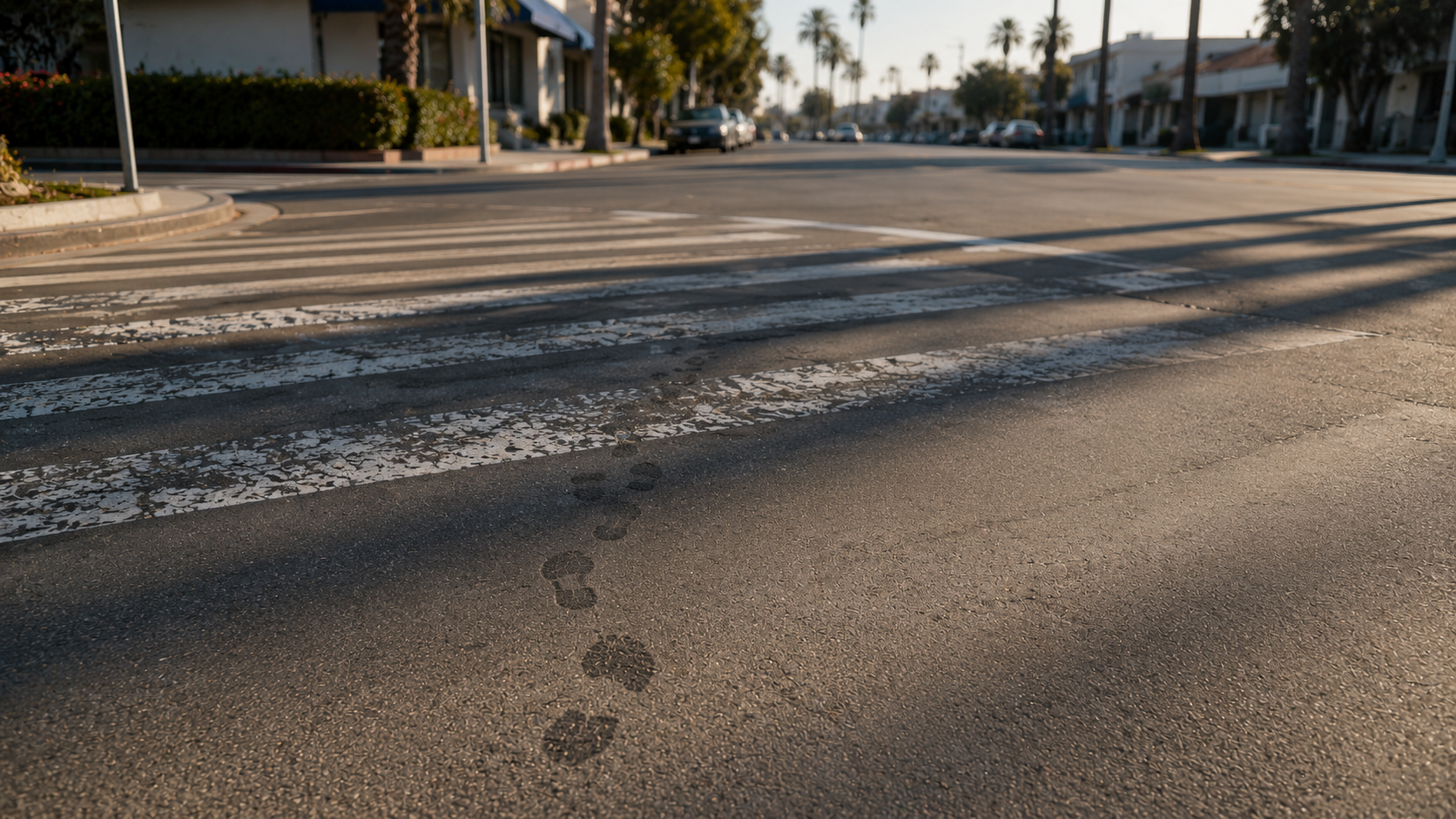
A woman crosses Sunset Boulevard mid-block on her way to her car. A driver, looking at his phone, drifts into the parking lane and hits her. She fractures her hip.
When her attorney calls the driver's insurer to settle, the adjuster says — confidently, almost casually — "Well, she was jaywalking, so we're looking at significant comparative fault on her end."
There's just one problem with that sentence: jaywalking has not been a crime in California since January 1, 2023.
The adjuster either doesn't know, or is counting on the pedestrian not knowing. Either way, the result is the same: a claim that should pay out at full value gets quietly discounted by 30 to 50 percent before negotiations even begin.
This is the jaywalking myth. It costs California pedestrians millions of dollars every year. And almost no one is talking about it.
the law most people don't know changed
On September 30, 2022, Governor Newsom signed Assembly Bill 2147 — known as the Freedom to Walk Act. The law took effect on January 1, 2023.
In plain English: California police officers can no longer stop or cite a pedestrian for jaywalking unless there is "an immediate danger of a collision." Crossing mid-block, crossing against the light, or crossing outside a crosswalk — when no immediate collision risk exists — is no longer illegal.
This was a significant change. For nearly a century, jaywalking was a low-grade infraction used disproportionately against low-income Californians and Californians of color. The Freedom to Walk Act ended that.
It also, almost by accident, transformed the legal landscape of pedestrian injury claims.
What the law actually says
Vehicle Code § 21955 — the old jaywalking statute — was amended. The new language permits officers to stop a pedestrian only when:
- A reasonably careful person would realize there is an immediate danger of collision, and
- The pedestrian's actions, viewed objectively, created that danger.
If neither condition is met, the pedestrian was not violating the law. They had a legal right to be where they were.
This matters enormously in a personal injury claim. The single most common defense in pedestrian cases — "the pedestrian was jaywalking" — has lost most of its force.
why insurance companies still use it against you
If jaywalking is no longer a crime, why are adjusters still bringing it up?
Three reasons:
Industry inertia
Insurance company claim software, training materials, and settlement databases were built around decades of California law that made jaywalking citable. The internal systems haven't caught up. Adjusters reach for "jaywalking" as a fault argument because that's what the playbook says. The playbook is wrong now, but the playbook hasn't been rewritten.
Cultural perception
Most Californians still believe jaywalking is illegal. Drivers believe it. Jurors believe it. Even some judges believe it. As long as the cultural assumption holds, insurers can extract settlement discounts by invoking "jaywalking" even when the legal foundation no longer exists.
Settlement leverage
Even if a case would clearly survive a comparative-fault challenge in court, the threat of trial — and the gamble of asking a jury to disregard their cultural intuitions — pushes injured pedestrians toward lower settlements. The insurer doesn't have to win the legal argument. They just have to make the legal argument credible enough to discount your offer.
What "jaywalking" actually means in califronia now
Here's where most pedestrians get confused — and where insurers exploit the confusion.
The Freedom to Walk Act did not eliminate all pedestrian rules. It changed when officers can cite, and indirectly, what counts as comparative negligence in a civil claim. The key shifts:
The burden has flipped. It is now the driver — and their insurer — who must prove the pedestrian created an immediate danger. The pedestrian no longer has to prove they were following the rules.
This is a huge legal advantage. And almost no injured pedestrian knows about it.
THE TACTICS INSURANCE COMPANIES USE
Once an adjuster takes your claim, here is the script they will follow. Recognize each one:
"You weren't in the crosswalk"
Translation: We want you to believe that being outside a marked crosswalk is automatic fault. It isn't. Crossing mid-block is legal now in most circumstances. And — see below — most intersections have unmarked crosswalks that pedestrians have full right-of-way in, even though no white lines are painted.
"You darted out"
Translation: We're going to claim the driver had no chance to stop. This is a credibility argument, not a legal one. Witness statements, traffic camera footage, vehicle damage location, and crash physics all establish whether a "dart-out" actually happened. The adjuster's claim that it did is not evidence.
"You were on your phone"
Translation: We're going to suggest you were distracted. Even if true, your phone use does not extinguish your right of way. A driver who failed to yield to a pedestrian — distracted or not — is still negligent. See "The Distracted Pedestrian Bias" below.
"You were wearing dark clothing"
Translation: We're going to argue you were invisible. This argument has limited legal weight in California. A driver has a duty to look. Reduced visibility may be a factor in comparative negligence, but it is rarely the dominant factor, and the driver's failure to maintain a proper lookout remains the primary cause.
"There's a crosswalk fifty feet away — why didn't you use it?"
Translation: We want you to feel that you should have walked to the marked crosswalk. The Freedom to Walk Act explicitly addresses this. Pedestrians are not legally required to walk to the nearest marked crosswalk before crossing.
UNMARKED CROSSWALKS - THE SECRET MOST PEDESTRIANS DON'T KNOW
California Vehicle Code § 275 defines "crosswalk" to include not just painted crosswalks, but also the prolongation of the lateral lines of sidewalks at every intersection.
In plain English: every intersection has crosswalks, even when no white lines are painted. These are called unmarked crosswalks, and pedestrians crossing in them have the same legal protections as those in painted crosswalks.
This means:
- Walking from corner to corner across any intersection — even one with no painted crosswalk lines — is legal.
- Drivers must yield to you in unmarked crosswalks the same as in marked crosswalks.
- If a driver hits you in an unmarked crosswalk, claiming "she wasn't in a crosswalk" is factually wrong.
Insurance adjusters routinely deny this. They will say "there was no crosswalk there." They mean: no painted crosswalk. Painted crosswalks are a subset, not the whole category.
If you were crossing at an intersection — corner to corner — you were in a crosswalk. Period.
THE DISTRACTED PEDESTRIAN BIAS
The newest insurance industry argument: the distracted pedestrian.
Adjusters now ask, almost reflexively:
- Were you on your phone?
- Were you wearing earbuds?
- Were you texting?
- Were you looking down?
The implication is that phone use or headphones somehow forfeits a pedestrian's right of way. They do not.
California law does not require pedestrians to give up phone use or headphones to retain right of way. A driver still has the duty to:
- Maintain a proper lookout
- Yield to pedestrians in crosswalks (marked or unmarked)
- Drive at speeds that allow them to stop for pedestrians who appear in their path
- Avoid distracted driving themselves
The argument that a pedestrian on a phone is "comparatively negligent" relies on a bias-driven framing: that pedestrians are responsible for being seen and that drivers are responsible only for not seeing things that "jumped out." That is not the law. The law puts the affirmative duty on the driver.
If an adjuster spends more time asking about your phone than about the driver's actions, they are not investigating the crash. They are building a fault-shifting narrative.
WHAT THIS ACTUALLY COSTS
The pedestrian discount — the systematic shaving of claim value through outdated jaywalking arguments and distracted-pedestrian framings — has a measurable financial cost.


.png)